

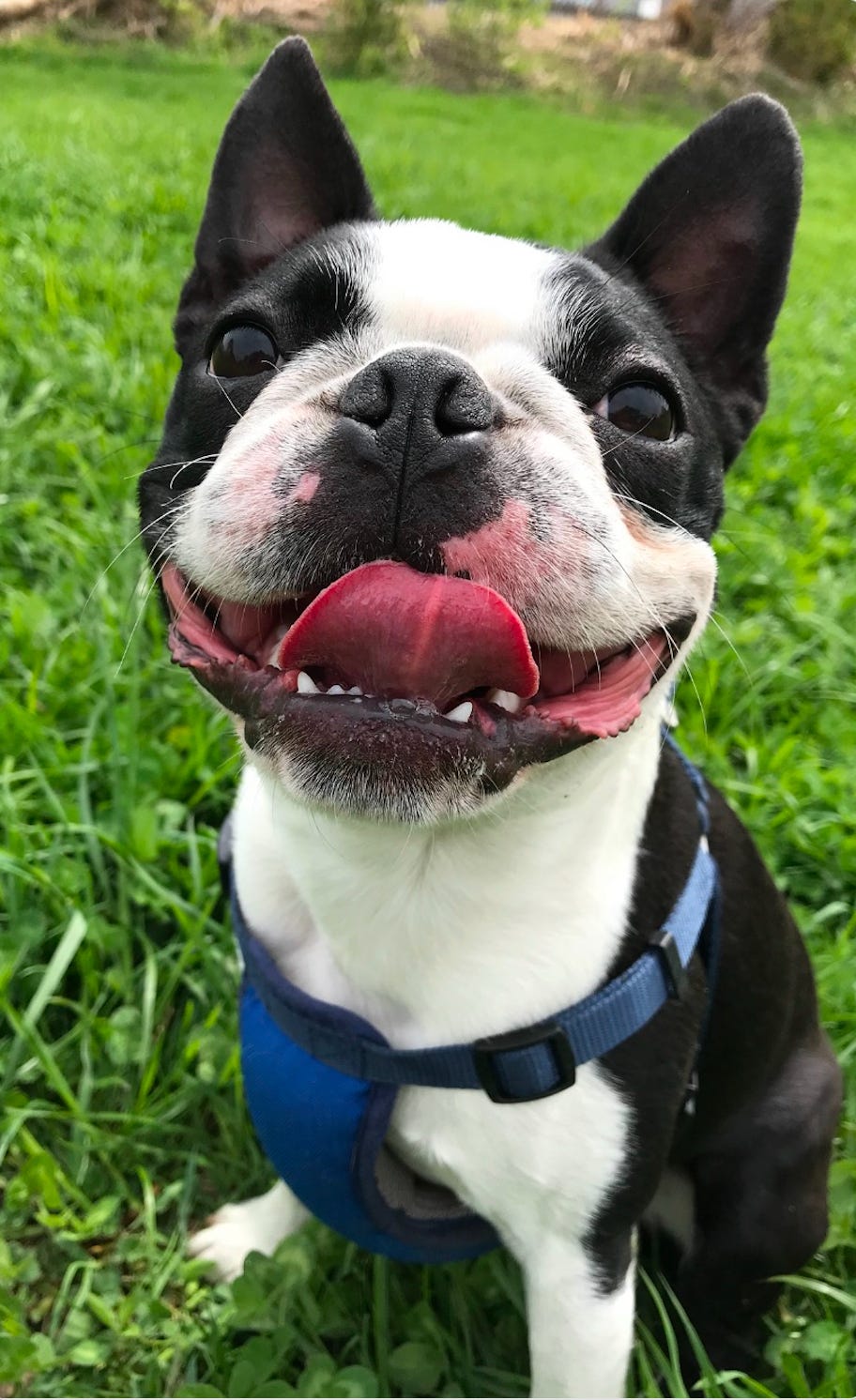
Dewey came to us from grief.
When we got him, I wanted him to be another dog. I wanted him to be our two-year-old Boston Terrier, Wayne, who had just died while we were on vacation. I wanted him to arrive as a clone, complete with the same wildness, inside jokes, and oversized ears.
Save for the ears, Dewey did not.
Right away, this 10-week-old puppy held eye contact in a way that was revealing. Unlike his predecessor, who jumped from speeding boats and snuck out from fenced-in yards, Dewey was sensitive, patient, and eager to please. He watched how we moved and delicately inserted himself into our lives.
I think back to Dewey’s puppyhood and wonder if he just took up the space we allowed. We were still grieving Wayne, and hardly took any photos of baby Dewey’s chubby, guinea pig-like frame. He played with hand-me-down toys and was passed off to neighbours who asked to have him over.
Half-heartedly, we taught Dewey to sit, walk on a leash, and stay. We didn’t have the energy for puppy training classes again, but he didn’t need anything more. He was good from the very beginning. He felt like an old soul, ready to bypass the basics to go in deeper.
I look back at this blip, nine years ago, and can't believe my own indifference. It shows me how hollow and depleting grief is. You toggle between wild fits of crying and a cool numbness where a Mack truck could roll over your toe without you even flinching. It’s the body’s way of shedding then protecting, shedding then protecting, until the sharpest parts are worn down and you’re only left with the aching core.
After that first summer, Dewey would become one of the greatest loves of my life.
We’d take him on countless flights to our East Coast cottage, tucked in a travel bag at our feet. During our stint as secret shoppers for a Chinese buffet chain, we snuck him into dozens of locations, where he’d lie silently under the table eating pieces of teriyaki meatball. At home, his bed was an oversized Icelandic sheepskin bean bag chair I’d bought off a fashion photographer.
Dewey travelled, ate, and dreamed alongside us.
Always one for the camera and equipped with a full-faced smile, he starred in our annual Christmas cards that featured a holiday “Dewey” pun: “Dewey hear what I hear?”, “All I want for Christmas is Dew,” and “I’ll have a Dew Christmas without you.” With a lukewarm reception, we’d mail the cards out to family and friends, cementing our reputation as dog-crazed DINKs.
Dewey was, objectively, very handsome. His black-and-white fur was so thick, it felt like a buzz cut running through your fingers. His ears smelled like crackers, or Tostitos, depending on the day. He was barrel-chested and wiggly. In his younger years, we would get stopped on the street.
As he grew older, and his lower deck of teeth finally surrendered to a tug-of-war-heavy summer with his best friend, Porkchop, people mostly commented on his smile.
To get Dewey amped up, all you needed to do was puff air in his direction. “Spider-Man fingers” had the same effect. If he saw the fingers, he’d race around the house, frantically looking for a toy.
Whenever we came home, he couldn’t contain himself. He’d immediately rush the door, jump on us both, cover us in kisses, then promptly disappear. He had so much excitement bubbling over that he had to grab a toy or down a few kibbles to regulate.
He spoke enough English to rival an average two-year-old. He knew “go get Papa” meant to look for Kevin. He’d scour the house until he located him. He could follow a finger point, knew the difference between going to the “truck” or “car”, and would stop dead in his tracks at a dramatic, off-Broadway gasp.
More often than not, when I went to the bathroom, he’d follow. When I showered, he would lie on the bathmat, then lick my wet legs when I got out. When Kevin played piano, he would sit at the pedals, seeming to absorb the music.
Complete with a drunk-uncle-level snore, Dewey was only allowed in bed in the morning. He’d wait until 6 a.m. to enter, jump onto the bed, and curl up behind our legs. He was a polite bathroom-goer, summiting the steep ravine in rain or snow to do his business, then sprint back.
He was always loyal, considerate, and constant.
Besides us, Dewey’s other great love was Chuckit. So much so that we couldn’t keep the ball inside. If a ball were tucked on the upper shelf of a closed pantry, he’d somehow find it and station himself nearby, whimpering all day and night.
One of my favourite things about Dewey was that despite fetch being his greatest passion, he was remarkably bad at it. Occasionally, the stars would align, and he’d leap like a Great White and snatch the ball out of the air. More often, the ball would bounce off some part of him or sail straight past. None of this ever discouraged him. He’d bring the ball back and eagerly await his next throw.
A gift from losing Wayne was that, besides those first weird weeks, we never took Dewey for granted.
Whatever reservations we have about telling our people how much we love them, we had none with Dewey. In a way that would appall both dog and non-dog people alike, I would kiss him on the lips and whisper in his ear, “Love you more than anything.” Sometimes at night, I’d wake up, go find him on his bean bag chair, and literally just breathe him in.
Wearing the scars of Wayne’s sudden passing, we helicoptered over Dewey. Whenever we were away, we worried. His wellbeing was our permission to unwind. His zoomies at the park were our gold-star satisfaction.
He was the barometer, the center, the thing that turned two adults into a family.
Naturally, our greatest fear was losing him. But at nine years old, despite having the teeth of a ring-toss carnie, he showed no signs of slowing down. He ran with gusto to catch and miss his ball, leapt enthusiastically across culverts, and nibbled our ears during his nightly witching hour.
This is what makes this next part so hard to write. It makes my stomach turn, and my breath tighten.
It was a day like every other. Dewey ate normally, went for a walk, and was even greenlit to have his Chuckit ball inside. We left for a couple of hours with no sign that anything was wrong. When we got home, Dewey greeted us at the door, jumping up and wagging his entire body.
It wasn’t until I put my hand in puke that I noticed anything was amiss. Even then, I thought it was just an upset stomach. But within the next forty-five minutes, before we could even get our bearings, things went from “he’s clearly not feeling well” to grey gums, cold paws, and a seizure-like collapse.
We rushed him to an emergency vet, but by the time we got there, he was gone. He died before we even got in the car, but neither of us was willing to admit it.
At the beginning of the summer, Dewey lay in the garden while I planted my basil and chilli peppers. The peppers have turned red, but he’s not alive to see me harvest them. There was one egg left in the container we cooked his final egg from, but I ate it this morning.
He had a final walk. A final poo. A final snuggle behind my legs.
We’re still sleeping in the same sheets, but soon we’ll move into a house he’ll never know.
We buried him at the farm near Wayne and a few other family dogs. My dad, a stoic dairy farmer with more minutes spent staring out windows than words spoken, shared something with us that morning. Whenever he mows past the place where the dogs are buried, he calls to them, one by one, out loud.
“Good boy, Wayne.”
“Good boy, Gus.”
“Good boy, Albert.”
“Good boy, Archie.”
And now, “Good boy, Dewey.”
Oh my goodness. What a beautiful post, and a fitting tribute for your best boy. The section at the end about your Dad finished me off. Dewey was lucky to have you, as you were him. ❤️
Oh Gracie, I am so sorry 😢 Dewey was a hilarious little boy. We are dog people. It comes at a price.