

A week ago, it was my birthday. Then, everyone died.
It started with a missed call. And a second.
I called my Mom back, who, through uncharacteristic tears, said to “hang on a sec” while she stepped outside. She was with my 97-year-old grandmother, whom we must mask all emotion from or fall victim to an excruciating line of questioning.
“Who’s sick?”
“What’s their doctor’s name?”
“Were they the ones that bought the old Hutchsinson farm on the 9th Line?”
On the phone, my Mom explained that Gus, their blimp-shaped Boston terrier, was about to die.
He was only eight and lived like a king. Or more accurately, like a former child star that peaked too early and spent his adult years binge-eating and sleeping the day away.
Note: Gus was, technically, a movie star. He appeared in Riot Girl, a 2019 feature film with a 4.5/10 IMDB score. He earned $300 for his minor yet integral role.
Gus is my dog’s littermate and polar opposite. Dewey rides hard, with a lower deck of missing teeth, a cauliflower ear, and a bulgedy-eye passion for Chuckit.
I always said that Gus, like someone in a medically induced coma, would live forever.
From day one, Gus’ energetic output hardly registered among the living. He was like a soft-handed developer who’d never seen the sun. He was well-preserved and untarnished, with a tank that never dipped below the three-quarter line.
I was in disbelief.
A few days earlier, Gus had been to the vet for a lump in his neck. The tests revealed advanced-stage lymphoma. I skimmed Reddit threads and cited miracles of dogs in three-year remissions. Naively, and perhaps a trait of the youngest-born, I thought we had a few good weeks, or even months left.
But here we were, my Mom’s voice cracking through the phone, saying that Gus was about to die. He’d been throwing up blood, had laboured breathing, and was too weak to stand.
The vet was coming in a couple of hours to put him down.
When she broke the news, I didn’t cry. I come from a family of non-cryers, and feel a duty to hold it together, even if it means dropping a deflective joke or coming across as indifferent.
I don’t like the overexposure of crying. Plus, once I start, I can’t stop.
I have a distinct memory of being five or six, watching The Fox and the Hound, and feeling tears well up. Instead of allowing myself to cry in the comfort of the living room, I went to the bathroom, sat on the toilet, and cried alone. Once composed, I reemerged to watch the final scenes with feigned unaffectedness.
Initially, I didn’t offer to drive the hour and a half to be there for Gus’ end. I had appointments in another city, and truthfully, I didn’t want to see Gus die. When we don’t see, we get to draw from our imagination. I wanted to draw a soft passing where life seamlessly fades into death.
As people who treat their dogs as seat-at-the-table family members with nicknames, rolodexes of greatest hits stories, and dinner time rituals that include “one dollop of sour cream on the side, not touching the kibbles”, we take the loss of our dogs hard.
To this day, with some level of guilt, the premature death of the first dog I got living on my own remains the most grief-stricken I’ve ever felt.
When I got the call that he died in his sleep, I was sleeping in a bunk bed at a Nashville hostel. I nearly rolled onto the floor. I cried so much my eyes swelled shut.
I remember looking around at happy people in cowboy boots, thinking, “Don’t they know what’s happened?”
I thought I’d never recover. My life got filed into a “before” and “after”. “After” was knowing that bad, unexplainable things can happen. One night, you can be eating Hattie B’s fried chicken, and by morning, this thing that you loved more than anything can be dead.
Admittedly, I see the privilege of this scenario. For my deepest marring of grief to be from a dog is entry-level.
However, it remains my clearest window into how inconceivable life after can feel.
While almost a decade ago, it still steals my breath.
It has made me clench at missed calls.
It has made me enter dark rooms to watch the rise and fall of breath.
It has made me redraw the depths of worsts imaginable.
But today, Gus, the brother of the dog that filled the void of my biggest loss, was going to die. And for my parents, and for him, I had to bear witness.
I got to the farm just ahead of the vet. Gus lay outside on his favourite blanket—a tacky, synthetic fleece with words like “believe” and “dream” written across it. As I walked over to him, he lay still. His eyes opened and closed heavily, and his breathing was choppy.
It’s surreal knowing that the life of another is about to end. That once the next vehicle drives down the long, gravel lane, we’ll be one less family member.
Until then, I sat next to him, patting his soft fur, before offering him a final piece of cheese.
“This will be the last thing he ever eats,” I thought. He didn’t eat it.
When the vet pulled in, I backed away. I didn’t want to be part of the final scene. I planned to go inside and re-emerge with feigned composure. But my parents and sister stayed close, so I held vigil.
A few minutes later, Gus was gone. We all cried together in private.
It’s strange, the way that grief behaves.
It doesn’t wait until you’ve processed one loss before introducing another. Perhaps grief is designed this way, stacked together like car dealerships on the edge of town.
That night, Kevin’s beloved Oma died.
She lived in a small village in Northern Germany and was a relic from another time.
When she spoke, everyone listened.
When she cooked, everyone ate.
When she joked, everyone laughed.
She had a not-to-be-messed-with attitude that felt anchoring and safe. There was nothing flippant or nonsensical about her.
She was the village bookkeeper, sharp as a tack. She remembered everyone’s name and birthday.
She fed her family by growing her own food and slaughtering their pigs. Kevin recounted seeing blood speckled across her oversized lenses. Her hands were the size of a baseball glove.
After the first family in the village got a TV and didn’t let anyone come over and watch it, she took out her first and only loan to buy one. Every evening, all the neighbourhood kids would pile into her tiny living room to watch whatever was on.
Her door was forever open.
She spoke German and Plaudietsch, sharing anecdotes and one-liners that cracked every room. Her children, grandchildren, and great-grandchildren stayed close, marvelling at her comedic timing.
Whenever we got to visit, she’d hug Kevin so tightly, she’d lift his 6-foot-three frame off the ground. She always remarked how much Kevin’s smile reminded her of her Dad. Our wedding photo sat close to her command center, a recliner and fold-out table next to the TV.
She loved watching detective shows, soccer, and hockey—just for the fights.
Recently, I came up with the nickname Bro-ma, but never got the chance to roll it out.
For Kevin, this call, the one where his Oma was dead, was his great fear. And now, it had happened.
Without hesitation, we flew to Germany for her funeral. I was afraid of how sad everyone would be. She was everyone’s favourite person, and the final connection to a world that no longer exists.
At the funeral, there were many tears. For me, hearing anyone’s long and wonderful life get reduced to a highlight reel always feels grossly deficient. But that wasn’t what lingered. It was the connection.
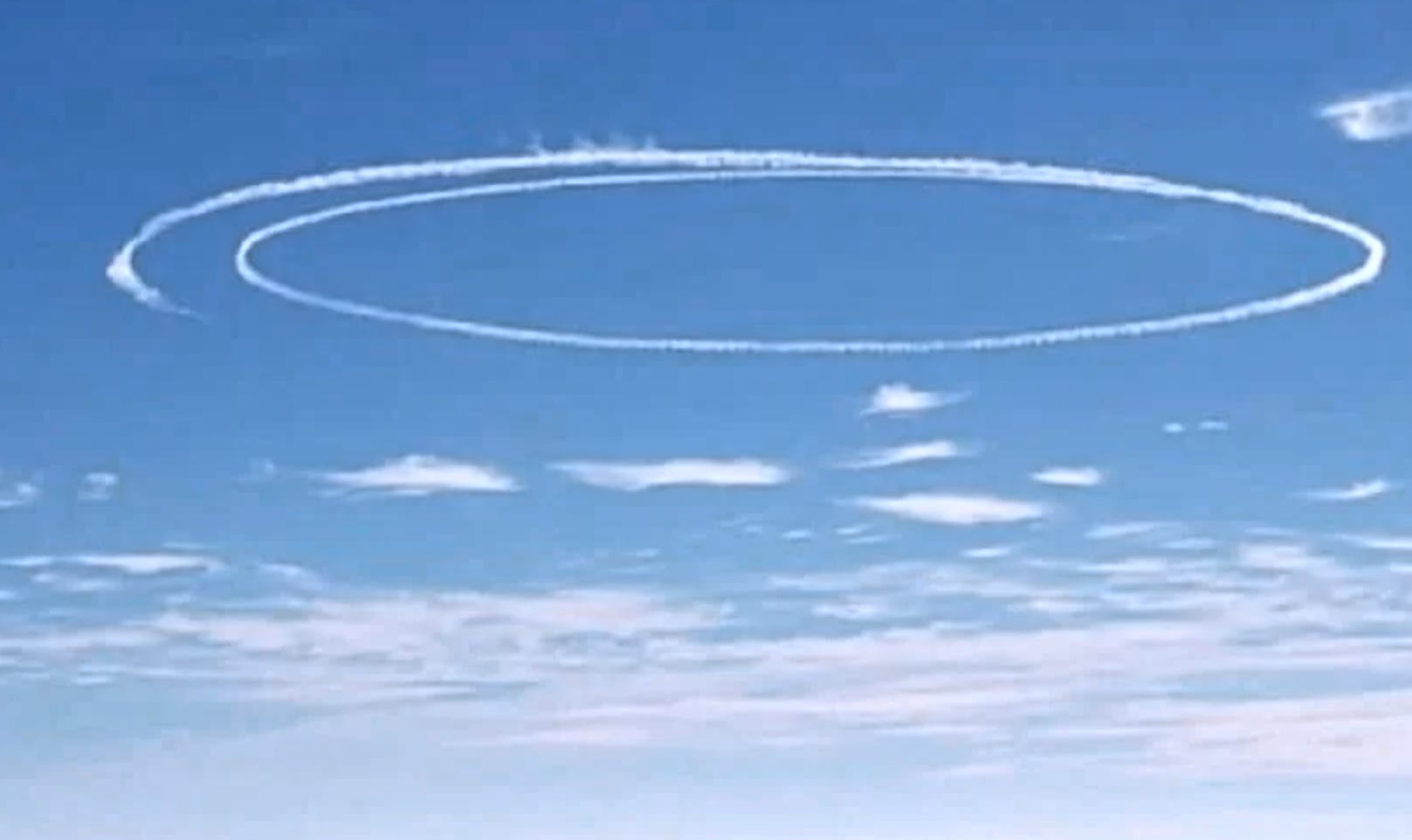
The morning of her funeral, everyone mentioned a large circle in the sky. It was a perfectly drawn white contrail.
Despite arriving from different villages and directions, we had all seen it.
I don’t know what happens after death.
But for a moment, we stood there together, eyes wide, looking at the same thing: a full circle somewhere between us and whatever happens next.
Oh, gosh, this made me tear up. I am so sorry for your losses. I have lost my grandparents by now and it's as if a piece of your childhood goes with them. Never had a dog as a kid, but I can imagine how that could feel like that too. My dog Fantastico is now the one that brings me the most joy, I cannot imagine losing him. I am sure Gus had a lovely life, and how nice that he was loved til his last day. Sending you a big virtual hug!
Oh Grace, this was so, so beautiful. This part was so, SO relatable:
"When she broke the news, I didn’t cry. I come from a family of non-cryers, and feel a duty to hold it together, even if it means dropping a deflective joke or coming across as indifferent.
I don’t like the overexposure of crying. Plus, once I start, I can’t stop."
I am so sorry you had to experience these two painful losses so close together. But this was the most beautiful tribute. Thank you for choosing to share this with us. 🤍💔